Thoughts
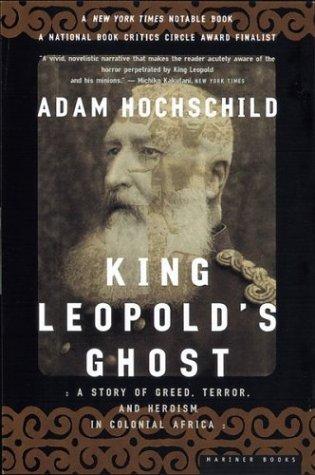
I came across this book when randomly doomscrolling Reddit. I’d never heard of King Leopold II, and I can confidently say I’ve read + watched all I want to about him now, the scumbag. I had no idea Belgium kicked off the “gentleman’s colonialism”
Highlights
1. Front
Page 7 @ 2025-11-17 09:48:40
ruler much admired throughout Europe as a “philanthropic” monarch
Right. Now that’s a setup if anything.
Page 14 @ 2025-11-17 10:39:54
As I followed the intersecting lives of these men, I realized something else about the terror in the Congo and the controversy that came to surround it. It was the first major international atrocity scandal in the age of the telegraph and the camera.
I don’t think many get this off the bat. This is something that’s still happening, and this was the first.
2. THE FOX CROSSES THE STREAM
Page 92 @ 2025-11-17 12:41:10
Marquis de Compiegne, who had gone up the Ogowe River in Gabon, and Germany’s Gerhard Rohlfs, who had had himself circumcised so that he could pass for a Muslim while trekking to remote parts of the Sahara
Now that’s a sentence.
Page 97 @ 2025-11-17 12:54:07
He had learned from his many attempts to buy a colony that none was for sale; he would have to conquer it. Doing this openly, however, was certain to upset both the Belgian people and the major powers of Europe. If he was to seize anything in Africa, he could do so only if he convinced everyone that his interest was purely altruistic. In this aim, thanks to the International African Association, he succeeded brilliantly. Viscount de Lesseps, for one, declared Leopold’s plans “the greatest humanitarian work of this time.”
This reeks of someone who was about to throw a tantrum that he was too late to the game and decided to rig it with his dad’s money. And that’s the thing, Leopold I was supposedly an all-around good guy.
3. THE MAGNIFICENT CAKE
Page 115 @ 2025-11-17 16:18:09
a French officer who happened to be visiting Uganda at this time later said that Stanley convinced the emperor only by telling him that Christians had eleven commandments. The eleventh was: “Honor and respect kings, for they are the envoys of God.”
I have heard of the “Dr. Livingston I presume” fellow before, but Hochschild really doesn’t seem to like him. Online discourse around Stanley seems divided.
Page 118 @ 2025-11-17 16:22:59
Readers got their money’s worth. Pre-electronic though they were, Stanley’s books were multimedia productions.
Page 129 @ 2025-11-17 16:46:22
Stanley would not allow porters ill with smallpox to stay behind and convalesce, or even to walk off into the forest to die; he made them carry their loads until they dropped.
Ah yes.
Page 133 @ 2025-11-17 16:48:53
I’m sure if I quite openly charged Stanley with the task of taking possession in my name of some part of Africa, the English will stop me. If I ask their advice, they’ll stop me just the same. So I think I’ll just give Stanley some job of exploration which would offend no one, and will give us the bases and headquarters which we can take over later on." Above all, Leopold told his man in London, “I do not want to risk … losing a fine chance to secure for ourselves a slice of this magnificent African cake.”
This guy keeps getting worse as I read about him.
5. FROM FLORIDA TO BERLIN
Page 187 @ 2025-11-25 19:59:55
Long before Stalin, who also edited writers’ manuscripts with his own hand, Leopold knew the uses of rewriting history.
Propaganda at its finest. George Orwell be damned.
Page 201 @ 2025-11-25 20:05:12
At last, at age fifty, Leopold had the colony he had long dreamed of.
A late bloomer, according to Queen Victoria.
7. THE FIRST HERETIC
Page 258 @ 2025-11-25 21:57:47
In a letter Williams wrote to the American secretary of state, he used a phrase that seems plucked from the Nuremberg trials of more than half a century later. Leopold’s Congo state, Williams wrote, was guilty of “crimes against humanity.”
I’ll be damned if this guy led to the birth of that phrase.
8. WHERE THERE AREN’T NO TEN COMMANDMENTS
Page 279 @ 2025-11-25 23:07:28
a central tool of Leopold’s Congo, which in the minds of the territory’s people, soon became as closely identified with white rule as the steamboat or the rifle. It was the chicotte —a whip of raw, sun-dried hippopotamus hide, cut into a long sharp-edged corkscrew strip. Usually the chicotte was applied to the victim’s bare buttocks. Its blows would leave permanent scars; more than twenty-five strokes could mean unconsciousness; and a hundred or more—not an uncommon punishment—were often fatal
It is insane how many times a whip of some form comes for the oppressed. Whether on the cotton fields, or in the rainforests. We learn later that colonialists in South America also used such whips.
Page 284 @ 2025-11-25 23:09:49
Just as terrorizing people is part of conquest, so is forcing someone else to administer the terror.
I need to quote this to other people.
9. MEETING MR. KURTZ
Page 325 @ 2025-11-26 19:45:48
It would be almost a decade before the aspiring steamship captain managed to get down on paper the other features of the Congo not shown on the map, and by that time, of course, the world would know him as Joseph Conrad.
I should have known.
Page 337 @ 2025-11-26 19:51:45
Heart of Darkness is one of the most scathing indictments of imperialism in all literature, but its author, curiously, thought himself an ardent imperialist where England was concerned. Conrad fully recognized Leopold’s rape of the Congo for what it was: “The horror! The horror!” his character Kurtz says on his deathbed. And Conrad’s stand-in, Marlow, muses on how “the conquest of the earth, which mostly means the taking it away from those who have a different complexion or slightly flatter noses than ourselves, is not a pretty thing when you look into it too much.” Yet in almost the same breath, Marlow talks about how the British territories colored red on a world map were “good to see at any time because one knows that some real work is done in there”; British colonialists were “bearers of a spark from the sacred fire.” Marlow was speaking for Conrad, whose love of his adoptive country knew no bounds: Conrad felt that “liberty … can only be found under the English flag all over the world.” And at the very time he was denouncing the European lust for African riches in his novel, he was an investor in a gold mine near Johannesburg.
Page 338 @ 2025-11-26 19:52:17
Conrad was a man of his time and place in other ways as well. He was partly a prisoner of what Mark Twain, in a different context, called “the white man’s notion that he is less savage than the other savages.” Heart of Darkness has come in for some justified pummeling in recent years because of its portrayal of black characters, who say no more than a few words. In fact, they don’t speak at all: they grunt; they chant; they produce a “drone of weird incantations” and “a wild and passionate uproar”; they spout “strings of amazing words that resembled no sounds of human language … like the responses of some satanic litany.” The true message of the book, the Nigerian novelist Chinua Achebe has argued, is: “Keep away from Africa, or else! Mr. Kurtz … should have heeded that warning and the prowling horror in his heart would have kept its place, chained to its lair. But he foolishly exposed himself to the wild irresistible allure of the jungle and lo! the darkness found him out.”
10. THE WOOD THAT WEEPS
Page 343 @ 2025-11-28 10:37:44
Seldom does history offer us a chance to see such detailed instructions for those carrying out a regime of terror. The tips on hostage-taking are in the volume of the manual called Practical Questions, which was compiled by an editorial committee of about thirty people. One member—he worked on the book during a two-year period following his stint as the head-collecting station chief at Stanley Falls—was Léon Rom.
This bastard wrote manuals on torture. Pol Pot would be proud.
Page 349 @ 2025-11-26 19:56:49
Stanley’s painful inhibitions are a reminder that the adventurers who carried out the European seizure of Africa were often not the bold, bluff, hardy men of legend, but restless, unhappy, driven men, in flight from something in their past or in themselves. The economic explanations of imperial expansion—the search for raw materials, labor, and markets—are all valid, but there was psychological fuel as well.
Page 349 @ 2025-11-28 16:30:32
For each cartridge issued to their soldiers they demanded proof that the bullet had been used to kill someone, not “wasted” in hunting or, worse yet, saved for possible use in a mutiny. The standard proof was the right hand from a corpse. Or occasionally not from a corpse. “Sometimes,” said one officer to a missionary, soldiers “shot a cartridge at an animal in hunting; they then cut off a hand from a living man.” In some military units there was even a “keeper of the hands”; his job was the smoking.
What is it with the economics of bullets and human life. There’s a Rajamouli and RRR joke here that imperial-sympathizers will not like.
13. BREAKING INTO THE THIEVES’ KITCHEN
Page 444 @ 2025-12-02 16:54:09
Stanley had cut off his own dog’s tail, cooked it, and fed it to the dog to eat
If there’s one thing I need to remember about Henry Morton Stanley, it is this.
14. TO FLOOD HIS DEEDS WITH DAY
Page 491 @ 2025-12-02 18:40:01
Breakfast was just finished when an African father rushed up the veranda steps of our mud house and laid upon the ground the hand and foot of his little daughter, whose age could not have been more than 5 years.
Holy Vishnu in Vaikunta.
15. A RECKONING
Page 510 @ 2025-12-02 18:50:09
Leopold’s men were looking for labor. If, in the course of their finding and using that labor, millions of people died, that to them was incidental. Few officials kept statistics about something they considered so negligible as African lives.
Incidental you say. No records you say?
17. NO MAN IS A STRANGER
Page 606 @ 2025-12-03 16:27:11
Less than a year later, she remarried—her husband none other than the former French officer, Durrieux, her original boyfriend and pimp. If she shared some of her fortune with him, his was surely one of the most successful feats of pimpery of all time.
I admit I laughed at the word “pimpery”.
18. VICTORY?
Page 626 @ 2025-12-03 16:36:34
Not long before his death, it turned out, Leopold had surreptitiously ordered the establishment of a foundation, based in Germany, to which he transferred some twenty-five million francs’ worth of paintings, silverware, crystal, jewelry, furniture and the like, plus another twenty million francs in securities. Some of the foundation’s income was to be reinvested, its charter said, and the remainder was to be spent—“according to the directions left by the Founder”—on the grand, showy projects he loved: palaces, monuments, and public buildings. He was afraid that future small-minded Belgian governments would not spend money in such ways, and he was also trying, as always, to keep his wealth from going to Louise, Stephanie, and Clementine. “The king has but two dreams,” a former Cabinet minister reportedly said during Leopold’s last years; “to die a billionaire, and to disinherit his daughters.”
The man was so damned spiteful towards his own children, he let his whore and her pimp have it all?
Page 628 @ 2025-12-03 16:37:27
Somerset Maugham eventually bought one of the king’s many Riviera villas. The grounds of another were turned into a zoo, known today for its troupe of performing chimpanzees.
Now that’s trivia for you.
Page 641 @ 2025-12-03 16:45:56
(There is a curious footnote to the story of the French Congo. Who, by way of strawmen and dummy corporations, was discovered to be a major shareholder in five of the concession companies there, and the majority shareholder in three of these? King Leopold II. Belgian government investigators discovered this in the course of trying to untangle Leopold’s finances after his death. Fearing that the French would be upset to find their Congo partly owned by the king next door, they successfully kept the news quiet for some years, and did not sell the shares until the 1920s. Leopold also held big blocks of shares in several concession companies in Germany’s Cameroons.)
Page 646 @ 2025-12-03 16:48:16
Sheppard continued to write and speak widely about Africa, even though, in his Southern Presbyterian church, this meant having to talk before segregated congregations. At different times, each of the two great archrivals, Booker T. Washington and W.E.B. Du Bois, invited Sheppard to join him on the speaker’s platform, and Sheppard obliged. But this man, who was so honored in the black community, who had been the first foreign visitor to meet the Kuba king, who had been received in the White House, had returned to an American South where he was still a second-class citizen. Years later, a white woman in Sheppard’s home town of Waynesboro, Virginia, said of him: “He was such a good darky. When he returned from Africa he remembered his place and always came to the back door.” When Sheppard died in Louisville at the age of sixty-two, in 1927, more than a thousand people came to his funeral.
“Such a good darky.”
19. THE GREAT FORGETTING
Page 672 @ 2025-12-03 17:04:53
“I will give them my Congo,” Leopold told Stinglhamber, “but they have no right to know what I did there.”
This bastard deserved to have his hands chopped off and fed to a dog.
Page 673 @ 2025-12-03 17:05:26
The voices which, in default of the destroyed archives, might speak in their stead have systematically been condemned to silence for considerations of a higher order." Seldom has a totalitarian regime gone to such lengths to destroy so thoroughly the records of its work. In their later quests for a higher order, Hitler and Stalin in some ways left a far larger paper trail behind them.
Being told that this dude was more meticulous at burning his path than Hitler and Stalin is surely something.
Page 673 @ 2025-12-03 17:05:56
The same kind of deliberate forgetting took place in the minds of the men who staffed the regime. Forgetting one’s participation in mass murder is not something passive; it is an active deed. In looking at the memories recorded by the early white conquistadors in Africa, we can sometimes catch the act of forgetting at the very moment it happens. It is not a moment of erasure, but of turning things upside down, the strange reversal of the victimizer mentally converting himself to victim.
It bears repeating. “Forgetting one’s participation in mass murder is not something passive; it is an active deed.” I wonder if right wing nationalists can even understand these lines.
Page 675 @ 2025-12-03 17:06:40
Sometimes, I think it is I who have suffered most. …Throughout history, people with blood on their hands have used such rationalizations. But the process of forgetting the killings of Leopold’s Congo received an unexpected boost when Belgium itself became victim instead of conqueror. Germany invaded it in August 1914, killed more than 5,000 Belgian civilians, and deliberately set fire to many thousands of buildings, including the renowned university library at Louvain.
Page 675 @ 2025-12-03 17:07:26
Newspaper stories, cartoons, posters, and patriotic speeches not only denounced the actual brutalities that had taken place; they went farther. The Germans, it was said, crucified Belgian babies on the doors of houses. And, in a striking but unconscious echo of the imagery of the Congo reform movement, the press in the Allied countries reported that German soldiers were cutting off the hands and feet of Belgian children.
Remember children, one genocide doesn’t make another one right. That’s how you spell Canaan.
Page 676 @ 2025-12-03 17:08:41
These shocking reports of severed hands and feet were so widespread that a rich American tried to adopt maimed Belgian children; but, even with offers of a reward, none could be found. In the end, the charges of crucifixion of babies and cutting off of children’s hands and feet turned out to be false. During and after the war, though, no one in the Allied countries wanted to be reminded that, only a decade or two earlier, it was the King of the Belgians whose men in Africa had cut off hands. And so the full history of Leopold’s rule in the Congo and of the movement that opposed it dropped out of Europe’s memory, perhaps even more swiftly and completely than did the other mass killings that took place in the colonization of Africa.
Page 700 @ 2025-12-03 17:24:57
At the time of the Congo controversy a hundred years ago, the idea of full human rights, political, social, and economic, was a profound threat to the established order of most countries on earth. It still is today.
Back
Page 703 @ 2025-12-03 17:25:57
Overlooking the beach at Leopold’s favorite resort at Ostend, Belgium, has long stood a grand equestrian statue of the king in bronze, surrounded by smaller figures of grateful Africans and local fishermen. One night in 2004, some anarchists sawed the hand off one of the Africans—to make the statue better represent, they said in an anonymous fax, Leopold’s real impact on the Congo.
Karma is something, I’m told.
Page 703 @ 2025-12-03 17:27:14
most of us have been brought up to think that the tyrannies of our time worth writing about are communism and fascism. Unconsciously, we feel closer to the victims of Stalin and Hitler because they were almost all European. Consciously, we think that communism and fascism represented something new in history because they caused tens of millions of deaths and had totalitarian ideologies that censored all dissent. We forget that tens of millions of Africans had already died under colonial rule. Colonialism could also be totalitarian—what, after all, was more so than a forced labor system? Censorship was tight: an African in the Belgian Congo had no more chance of advocating freedom in the local press than a dissident in Stalin’s Soviet Union. Colonialism was also justified by an elaborate ideology, embodied in everything from Kipling’s poetry and Stanley’s lectures to sermons and books about the shapes of skulls, lazy natives, and the genius of European civilization. And to speak, as Leopold’s officials did, of forced laborers as libérés, or “liberated men,” was to use language as perverted as that above the gate at Auschwitz, Arbeit Macht Frei. Communism, fascism, and European colonialism each asserted the right to totally control its subjects’ lives. In all three cases, the impact lingered long after the system itself officially died.
Page 712 @ 2025-12-03 17:30:32
not a single article—nor a single display case in the museum—was devoted to the foundation of the territory’s colonial economy, the forced labor system. Nowhere in either book or exhibit could you find the word “hostage.” This does not leave me optimistic about seeing the Congo’s history fully portrayed by the Royal Museum in the future. But colonialism seldom is, anywhere. Where in the United States can you find a museum exhibit dealing honestly with our own imperial adventures in the Philippines or Latin America?
That last line, where’s the chef’s kiss emoji?
Page 719 @ 2025-12-03 17:35:41
Multinational corporations have also been in on the take. What protects their interests now is no longer the old Force Publique but rather under-the-table agreements with the different national armies and Congolese factions. Just as ivory and rubber drove the search for profits in the old days, today these companies have been eagerly extracting the Congo’s diamonds, gold, timber, copper, cobalt, and columbium-tantalum, or coltan, which is used in computer chips and cell phones. Coltan has at times rivaled gold in price per ounce. The fighting has been over riches, not ideology; the worst combat sometimes shifted location with the rise and fall of relative commodity prices.